
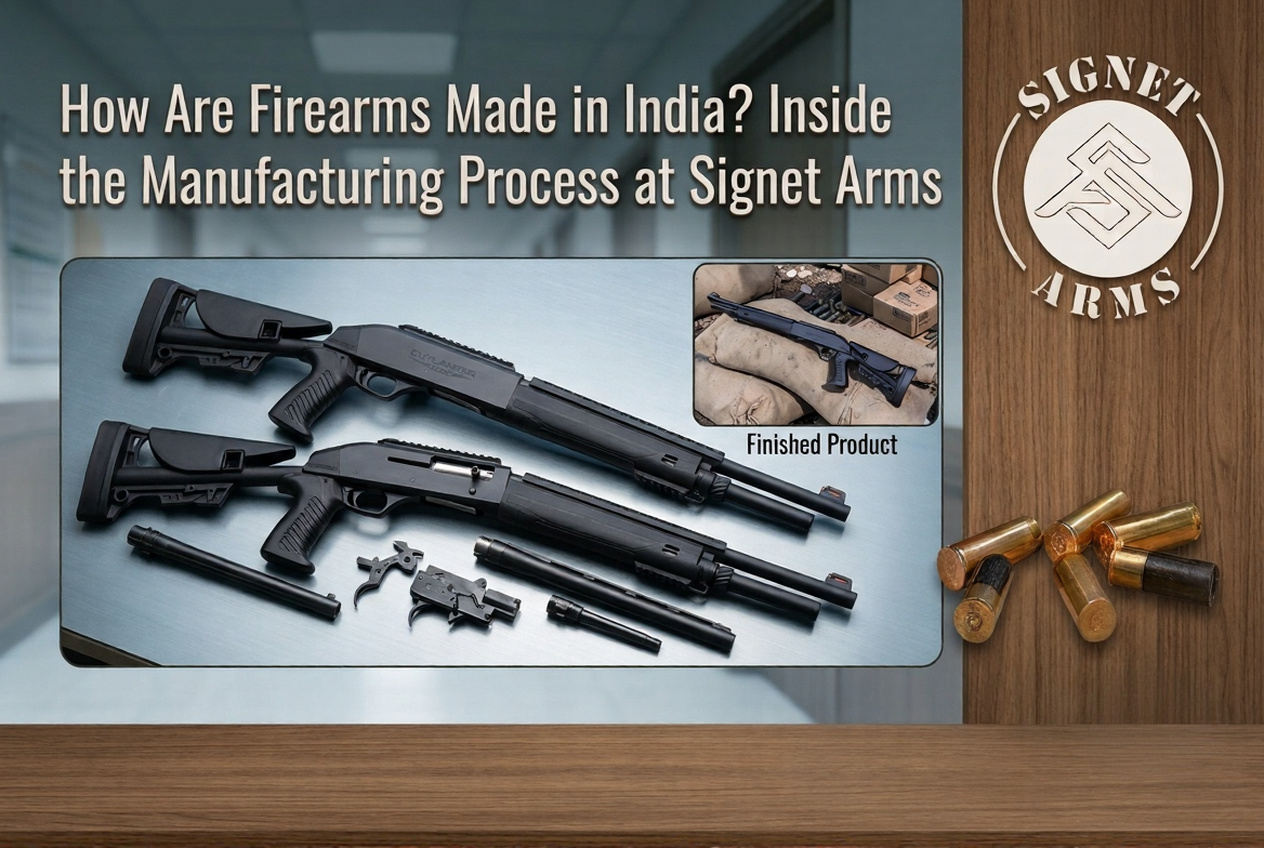
When people think about Firearms, they usually picture the finished product rather than the engineering, precision manufacturing, testing and compliance behind it.
In India, firearm production is a closely regulated industrial activity, where licensed manufacturers work within strict legal and quality-control requirements.
This article gives you a clear, easy-to-follow look at firearms manufacturing in India, the broad stages involved at a professional facility such as Signet Arms, the importance of firearm manufacturing process, firearm quality control, and Indian firearm manufacturers, as well as why traceability and regulatory compliance matter at every stage.
The focus here is on the manufacturing ecosystem and not on instructions for constructing or modifying firearms.
Understanding Firearms Manufacturing in India
The production of Firearms in India operates under a formal legal framework, primarily governed by the Arms Act, 1959 and the Arms Rules, 2016.
The Ministry of Home Affairs maintains the official rules and regulatory information for the sector.
Unlike ordinary metalworking, firearm production involves additional controls covering licensing, security, inspection, proof testing, records and identification markings.
Why Is Firearm Manufacturing So Regulated?
A firearm has to meet defined technical and safety requirements before it can enter the legal supply chain.
The Arms Rules also place responsibilities on licensed manufacturers relating to facility inspections, competent personnel, inventory records and secure handling of finished products.
That makes compliance an essential part of the manufacturing process rather than something added after production.
A Look Inside the Firearm Manufacturing Process
The exact production methods used by a manufacturer can be proprietary. At a broad level, however, the firearm manufacturing process involves engineering, material preparation, precision production, finishing, controlled assembly and extensive inspection.
Engineering and Design
Manufacturing starts with an approved design and defined technical specifications. Engineers consider factors such as dimensions, materials, manufacturing tolerances and the intended product category.
Modern manufacturing environments may use computer-aided design and precision production systems to improve repeatability.
The objective is consistency: components need to conform to established specifications from one production batch to another.
Material Selection and Component Production
Once specifications are established, appropriate engineering materials are selected for individual components.
Manufacturing then takes place using industrial equipment designed for precise production.
The important point is that professional manufacturing is not simply about shaping metal.
Each component passes through controlled processes and inspections intended to ensure that it meets the required specifications.
Finishing and Surface Treatment
After components are produced, suitable finishing processes may be used to achieve the required surface characteristics and durability.
Finishing can also contribute to corrosion resistance and overall product quality. In a regulated manufacturing environment, appearance is only one part of the equation; consistency and compliance remain central.
Quality Control Is at the Heart of Production
For Firearms, manufacturing quality is especially important because products must perform consistently under demanding operating conditions.
Inspection During Production
Quality checks can take place throughout production rather than only at the end. Manufacturers may examine dimensions, materials, workmanship and other defined characteristics at different stages.
This approach helps identify problems before a product moves further through the production line.
Proof Testing and Regulatory Checks
Proof testing is an important part of India’s regulated firearm manufacturing framework.
Government licensing records can specifically identify manufacturers authorised to manufacture and proof-test specified firearms.
The Arms Rules also require licensed manufacturers to maintain appropriate controls around production, technical competence, inspections and inventory.
These requirements illustrate why firearm quality control is much broader than a simple visual inspection.
Assembly and Final Inspection
Once approved components have passed their required checks, they move through controlled assembly and final inspection.
Controlled Assembly
Assembly in a professional facility is performed according to established manufacturing specifications.
The aim is to ensure that the completed product corresponds with its approved design and production standards.
At this stage, consistency matters just as much as the individual components themselves. A finished product must satisfy the manufacturer’s quality system before it can proceed further.
Final Verification
Final checks can cover product identification, workmanship, documentation and other applicable requirements.
Depending on the product and licence, additional testing and proof-related requirements may apply.
The process is therefore built around verification rather than simply completing physical assembly.
Marking and Traceability of Firearms
One of the less visible but important parts of regulated firearm production is product identification.
Under the Arms Rules, firearms manufactured in India are required to carry specified markings, including information such as the country of manufacture, manufacturer name, unique serial number, year of manufacture, type or model, calibre and proof marks.
Why Traceability Matters
Traceability allows authorities and manufacturers to connect a finished firearm with its manufacturer and relevant records.
It supports accountability throughout the legal supply chain and makes record management an important part of the industry.
The rules also require licensed manufacturers to maintain inventory and distribution-chain records.
What Makes Modern Firearm Manufacturing Different?
Signet Arms
Modern firearms manufacturing in India combines traditional engineering knowledge with industrial production systems, quality control and regulatory oversight.
A professional manufacturer like Signet Arms has to think about much more than production speed.
Consistency, documentation, secure storage, qualified personnel, inspection and legal compliance all influence how a manufacturing facility operates.
That is what separates a regulated manufacturing environment from informal or unauthorised production.
FAQs About Firearms Manufacturing in India
1. Are Firearms legally manufactured in India?
Yes. Firearm manufacturing is legally permitted for appropriately licensed entities operating under India’s applicable arms laws and regulations.
The Arms Rules, 2016 establish the regulatory framework for manufacturing activities.
2. Is Signet Arms a licensed firearm manufacturer?
Yes. Signet Arms is a licensed firearm manufacturer in India, operating from its purpose-built manufacturing facility near Rewa, Madhya Pradesh.
The company manufactures firearms under India’s applicable arms-control and manufacturing regulations, with its production incorporating automated manufacturing and quality-assurance processes.
3. What are the main stages of firearm manufacturing?
At a high level, the process includes engineering and material selection, precision component production, finishing, controlled assembly, inspection, testing and documentation.
4. Why is quality control important in Firearms manufacturing?
Quality control helps manufacturers maintain consistency, identify defects and ensure that products meet applicable technical, testing and regulatory requirements.
5. What is proof testing?
Proof testing is a regulated testing activity associated with firearm manufacture. It forms part of the broader safety and compliance framework for licensed manufacturers.
6. Are Firearms marked for identification?
Yes. The Arms Rules specify required identification information for manufactured firearms, including the manufacturer’s name, unique serial number, year of manufacture and other prescribed details.
Conclusion
The making of Firearms in India is far more than a straightforward industrial production exercise.
It combines engineering, precision manufacturing, controlled assembly, inspection, proof testing, traceability and strict regulatory compliance.
Signet Arms provides an example of how a private-sector manufacturer can operate within this regulated environment, with government records documenting its specified manufacturing and proof-testing licences.
For anyone interested in Indian firearm manufacturers, understanding these systems offers a better picture of what goes into professional production.
Behind every legally manufactured firearm is a combination of technical standards, quality procedures and regulatory responsibilities designed to keep the manufacturing and supply chain accountable.