
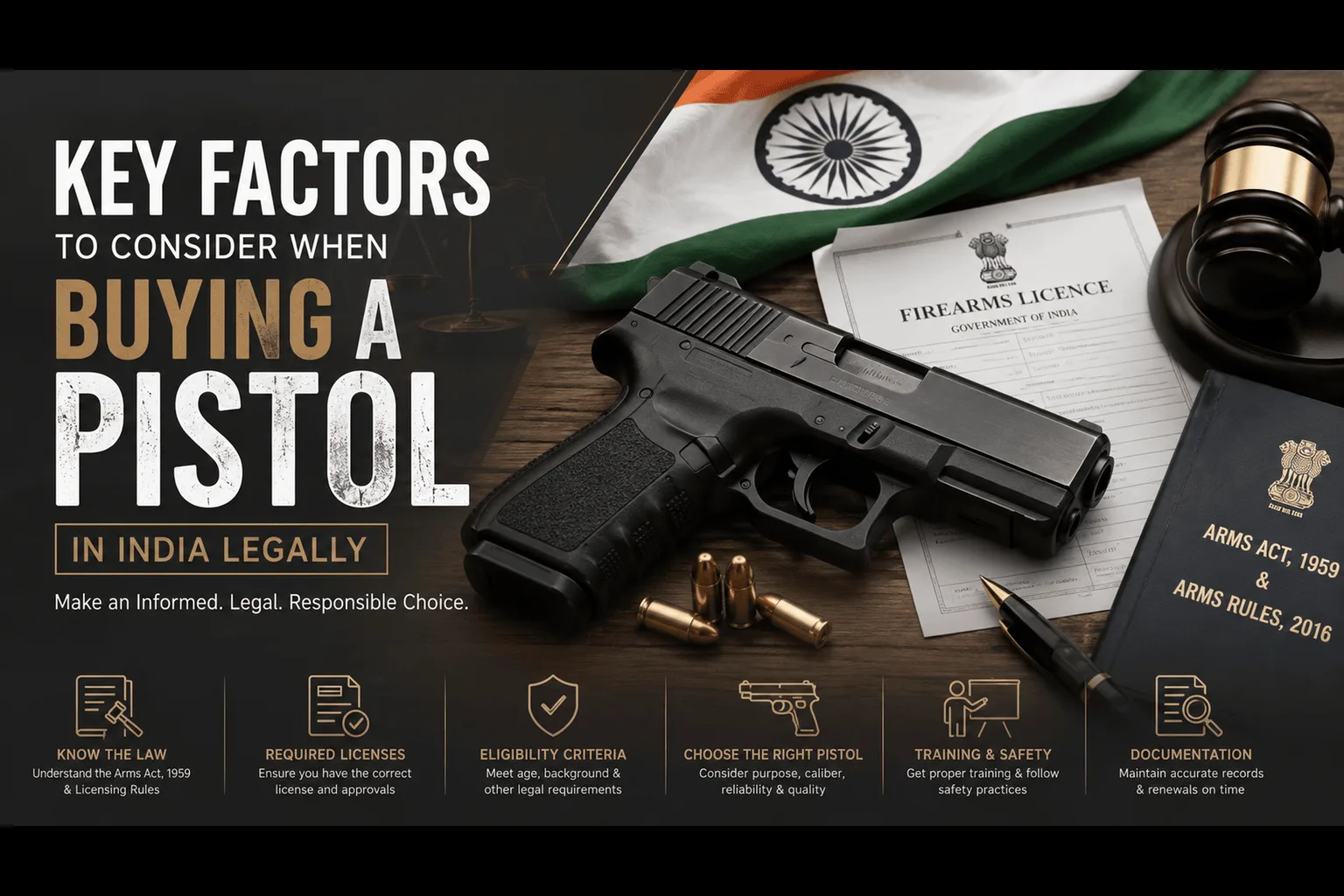
Owning a pistol in India is legal, but it is far more tightly regulated than in many other countries.
Firearm ownership is governed primarily by the Arms Act, 1959 and the Arms Rules, 2016, and the entire process from applying for a license to purchasing ammunition is closely monitored by the government.
If you’re considering buying a pistol legally in India, here are the key factors you need to understand before you begin.
1. Understand That a License Comes Before the Gun
In India, you cannot walk into a shop and buy a pistol the way you might buy other consumer goods.
You must first obtain an Arms License from the appropriate licensing authority, typically the District Magistrate (DM), the Commissioner of Police (in metro areas), or, for certain categories, the State Government.
Only once you hold a valid license can you legally purchase, possess, or carry a firearm.
Attempting to acquire a firearm without a valid license is a criminal offense under the Arms Act, regardless of intent, so this is the non-negotiable starting point for any legal purchase.
2. Know the Difference Between Prohibited and Non-Prohibited Bore
Firearms in India are classified into two broad categories:
- Non Prohibited Bore (NPB) – This is the category available to ordinary civilians who qualify for a license. Most legally owned civilian pistols and revolvers fall under this category.
- Prohibited Bore (PB) – This includes automatic and military-grade weapons, along with certain higher-caliber handguns.
PB licenses are reserved for very specific cases, such as individuals facing a documented, verified threat to their life, certain government officials, or those connected to anti-terrorism duties.
These licenses are issued by the central government and are extremely difficult for an ordinary citizen to obtain.
For nearly all first-time civilian applicants, the realistic path is an NPB license, and calibers are further restricted for civilians commonly limited to options such as .32, .22, and .380, with anything beyond that handled on a case-by-case basis.
3. Meet the Basic Eligibility Criteria
Before applying, make sure you meet the baseline eligibility requirements:
- Citizenship – You must be an Indian citizen.
- Age – Applicants are generally required to be at least 21 years old, with limited training-related exceptions for younger individuals under close adult supervision.
- Clean criminal record – You must have no serious criminal convictions or pending criminal cases, particularly none involving violence or firearm misuse.
- Sound mental health – A medical certificate confirming mental fitness is typically required.
- Good character and background – Police verification will assess your reputation, family background, and any history of anti-social conduct.
Failing to meet any of these will result in an application being denied at the outset, so it’s worth honestly assessing your eligibility before investing time and money in the process.
4. Establish a Genuine, Documented Need
Licensing authorities don’t grant firearm licenses simply because someone wants a pistol. You must demonstrate a legitimate, documented reason, which generally falls into one of a few recognized categories:
- Personal protection, where your profession, past threats, or specific circumstances create a genuine and demonstrable risk to your life or property.
- Sport shooting, where you are an active, verifiable member of a licensed shooting club or rifle association, typically for a minimum period (often around two years), and are pursuing structured target practice.
- Service-related eligibility, for those currently serving in or retired from the armed forces, central armed police forces, or similar organizations.
Whichever category applies to you, be prepared to back it up with supporting documentation. Vague or unsubstantiated claims of “self-defense” are unlikely to succeed without evidence.
5. Prepare for a Thorough Verification Process
Once your application is submitted, expect a multi-step verification process that can take several weeks to several months. This typically includes:
- Local police verification of your address, character, and background.
- Review of your application by the licensing authority, including your stated reason for needing a firearm.
- Interviews or additional documentation requests, depending on your specific case.
- Registration through NDAL-ALIS the National Database of Arms Licenses Arms License Issuance System the centralized digital platform through which applications, licenses, and license-holder records are now managed nationally.
Patience matters here. Rushing the process or attempting to bypass verification steps will not speed things up and can jeopardize your application.
6. Understand the Costs Involved
Legally owning a pistol in India involves more than the purchase price of the firearm itself. Budget for:
- License application and processing fees, which vary by state and licensing authority.
- The firearm’s purchase price, which can range considerably depending on the make and model locally manufactured options (such as those from the Indian Ordnance Factory) are generally more affordable than imported firearms, which also carry additional duties and restrictions.
- Ammunition costs, noting that civilian license holders are typically subject to an annual ammunition purchase quota rather than unlimited buying.
- Secure storage, such as a certified gun safe or lockbox, which is often a practical necessity given legal storage expectations.
- License renewal fees, since arms licenses in India are not indefinitely permanent and must be renewed periodically (commonly every three years, though this can vary).
7. Choose Where You Buy Carefully
Once licensed, you must purchase your pistol from an authorized, licensed firearms dealer. Reputable dealers will:
- Verify your license details against the NDAL-ALIS database before completing a sale.
- Handle all required documentation and reporting to the licensing authority.
- Provide guidance on which models are legally available to you under your specific license category and caliber restriction.
Avoid any dealer or private seller who suggests bypassing documentation, license verification, or reporting requirements; doing so exposes you to serious legal liability, regardless of what you were told at the time of sale.
8. Know Your Ongoing Legal Obligations
Legal ownership doesn’t end at the point of purchase. As a license holder, you are responsible for:
- Safe and secure storage of the firearm at all times, separate from ammunition where required.
- Complying with transport rules, including how the firearm must be cased and declared if you move it between states or carry it in public.
- Reporting any loss, theft, or transfer of the firearm to the appropriate authorities without delay.
- Renewing your license on time and keeping your registered details current in the NDAL-ALIS system.
- Using the firearm only within the scope of your license a self-defense license does not, for example, entitle you to use the firearm for purposes outside that stated need.
Violating any of these ongoing obligations can result in license suspension, confiscation of the firearm, or criminal liability.
9. Consider Consulting a Professional
Given how state-specific and procedurally detailed the licensing process can be, many first-time applicants find it worthwhile to consult a lawyer familiar with arms licensing, or to speak directly and early with their local licensing authority, rather than relying solely on general information found online.
Requirements, processing times, and documentation can vary meaningfully from one state or city to another. You may also consider consulting a firm such as Signet Arms, which can help guide first-time applicants through the licensing and purchasing process.
Frequently Asked Questions
1. Can any Indian citizen apply for a pistol license?
In principle, yes any Indian citizen who meets the age, character, and mental health requirements can apply.
However, meeting the baseline eligibility criteria does not guarantee approval; you must also demonstrate a genuine, documented need, such as a verified personal security risk, active participation in sport shooting, or a service-related background.
2. How long does it take to get a pistol license in India?
Processing times vary significantly by state and licensing authority, but applicants should generally expect the process including police verification to take anywhere from a few weeks to several months.
Complex cases or those requiring additional documentation can take longer.
3. What calibers are civilians allowed to own?
Civilian NPB licenses are generally limited to specific calibers, most commonly .32, .22, and .380.
Anything beyond these, including higher-caliber or Prohibited Bore firearms, is restricted to special cases and is not available to typical first-time applicants.
4. Is self-defense alone a good enough reason to get a license?
Not on its own. You’ll need to demonstrate a specific, documented threat to your life or property rather than a general desire for personal protection.
Vague self-defense claims without supporting evidence are unlikely to be approved.
5. Can I buy a pistol online in India?
No. Even with a valid license, firearms must be purchased in person from an authorized, licensed dealer who will verify your license against the NDAL-ALIS database and handle the required documentation.
Firearms cannot be legally bought online or through unlicensed private sellers.
6. Do I need to renew my pistol license?
Yes. Arms licenses in India are not permanent and must be renewed periodically, commonly every three years, though exact renewal timelines can vary by state and license type.
Failing to renew on time can affect your legal standing as a firearm owner.
7. Is there a limit on how much ammunition I can buy?
Yes. Civilian license holders are typically subject to an annual ammunition purchase quota rather than unlimited buying, and purchases are tracked against your license.
8. What happens if my license application is denied?
If your application is denied, the licensing authority is generally required to provide a reason.
Depending on the grounds for denial, you may be able to appeal the decision or reapply later, particularly if you can address the specific concerns that led to the rejection (such as providing stronger documentation of genuine need).
9. Should I consult a professional before applying?
It’s often a good idea, given how state-specific and detailed the process can be. A lawyer familiar with arms licensing, or a firm such as Signet Arms, can help first-time applicants understand documentation requirements and avoid common mistakes that delay approval.
Final Thoughts
Buying a pistol legally in India is a deliberate, multi step process built around demonstrating genuine need, passing thorough verification, and committing to ongoing legal responsibilities as a license holder.
It is not a quick or casual purchase, and it isn’t meant to be. If you approach the process with patience, honest documentation of your need, and a clear understanding of the Arms Act and Arms Rules, you can navigate the system successfully and become a fully compliant, legal firearm owner in India.