
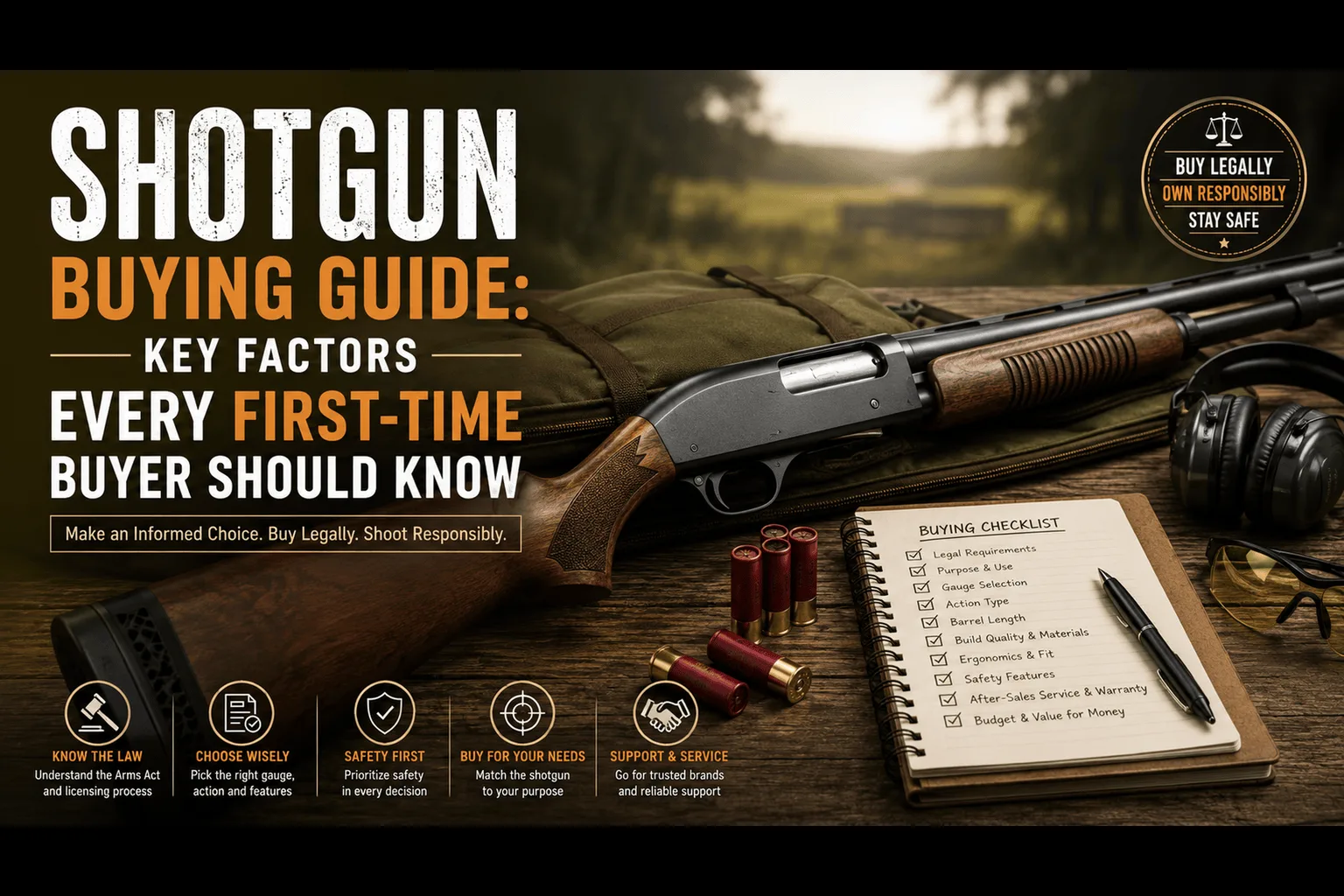
Buying your first shotgun can feel overwhelming. Walk into any gun shop and you’ll be met with a wall of options, different gauges, actions, barrel lengths, and price points, all before anyone asks what you actually plan to do with the gun.
The good news is that narrowing down the right shotgun isn’t complicated once you understand a handful of core factors.
This guide walks through what actually matters, so you can make an informed decision and, just as importantly, stay on the right side of the law throughout the process.
1. Start With Purpose, Not Product
The single biggest mistake first-time buyers make is shopping for a shotgun before deciding what it’s for.
Shotguns are remarkably versatile, but no single model excels at everything. Before you look at a single gun, ask yourself what you’ll primarily use it for:
- Hunting (upland birds, waterfowl, turkey, or big game with slugs)
- Clay target sports (trap, skeet, or sporting clays)
- Home defense
- General range use and recreational shooting
Each of these uses favors different features: barrel length, weight, choke options, and even gauge.
A shotgun optimized for breaking clays at the trap range will handle very differently from one built for home defense in tight hallways.
Defining your primary use case first will save you money and prevent buyer’s remorse.
2. Understand Gauge Before Anything Else
Gauge refers to the bore diameter of the shotgun, and it’s one of the first specs you’ll see on any listing.
Confusingly, the numbers work in reverse: a smaller gauge number means a larger bore. The most common gauges are:
- 12-gauge: The most popular and versatile option. Ammunition is widely available, prices are competitive, and it handles everything from home defense to waterfowl hunting to clay sports. If you’re unsure what to buy, a 12-gauge is rarely the wrong answer.
- 20-gauge: Lighter recoil and a lighter gun overall, making it a popular choice for new shooters, smaller-framed shooters, or upland hunters who carry their gun for miles. Slightly less ammunition variety than 12-gauge, but still very common.
- .410 bore: Technically not a “gauge” at all (it’s measured by bore diameter), the .410 has minimal recoil but also less payload, making it more of a specialist’s or experienced hunter’s tool rather than a beginner’s first choice.
- 16-gauge and 28-gauge: Niche options with dedicated followings, but ammunition can be harder to find and pricier.
For a first shotgun, 12-gauge or 20-gauge will cover the overwhelming majority of use cases and keep ammunition costs and availability manageable.
3. Choose the Right Action Type
The “action” refers to how the shotgun cycles and fires shells. Each type has trade-offs in cost, reliability, capacity, and learning curve.
- Break-action (single or double barrel): Simple, reliable, and easy to understand for beginners. You load one or two shells directly into the chamber.
Common for hunting and clay sports, and often the first gun many shooters learn on because of how intuitive it is to operate and how easy it is to visually confirm the gun is unloaded.
- Pump-action: You manually cycle the action between shots by racking the forend. Pump shotguns are durable, relatively affordable, and forgiving of a wide range of ammunition types. They’re a favorite for home defense and general-purpose use because of their reliability.
- Semi-automatic: Cycles automatically using recoil or gas operation, allowing faster follow-up shots with less felt recoil (gas-operated models in particular tend to soften recoil).
These tend to cost more and require more regular cleaning, but many shooters find them more comfortable to shoot over long range sessions.
If you’re brand new to shotguns, a pump-action is often recommended as a solid all-around starting point: it’s mechanically simple, widely available, affordable, and used across hunting, sport, and defensive contexts, so you’ll find no shortage of accessories, parts, and community knowledge.
4. Barrel Length Matters More Than You’d Think
Barrel length affects handling, weight, and how the shotgun performs in different scenarios:
- 18–20 inches: Common for defensive shotguns. Shorter barrels are easier to maneuver in tight spaces, though they can have slightly more felt recoil and muzzle blast.
- 26–28 inches: The sweet spot for most hunting and clay-sport shotguns. Longer barrels provide a smoother swing and more consistent sight picture on moving targets.
- 28+ inches: Favored in some trap-shooting disciplines where a longer sight plane helps with target acquisition at distance.
If you’re buying a single, do-it-all shotgun, a 26- or 28-inch barrel on a 12-gauge is the most flexible starting point, useful for hunting and clays alike, while still being manageable indoors if needed.
5. Chokes: The Overlooked Detail
A choke is a constriction at the end of the barrel that shapes how the shot pattern spreads. Tighter chokes (like Full or Modified) keep pellets grouped tightly for longer-range shots, while more open chokes (like Cylinder or Improved Cylinder) spread the pattern faster for close-range work.
Many modern shotguns come with interchangeable choke tubes, letting you swap chokes depending on the task tighter for distant birds, more open for close-flushing game or home defense.
If you expect to use your shotgun for multiple purposes, prioritize a model with interchangeable chokes rather than a fixed choke.
6. Fit Is Not Optional
A shotgun that doesn’t fit your body will be uncomfortable to shoot, harder to aim instinctively, and will produce more felt recoil than necessary. Fit depends on:
- Length of pull – the distance from the trigger to the end of the stock. Too long and you’ll struggle to mount the gun quickly; too short and your face will sit too close to the receiver.
- Stock height and comb – affects where your eye lines up with the sights or rib.
- Overall weight and balance – heavier guns absorb recoil better but tire your arms faster; lighter guns are easier to carry but kick more.
Whenever possible, physically handle and shoulder a shotgun before buying. Many gun shops and ranges allow this, and some ranges offer rentals so you can test-fire different models before committing.
7. Set a Realistic Budget
New shotguns can range from a few hundred dollars for a reliable entry-level pump gun to several thousand for a premium semi-automatic or competition-grade over/under.
As a first-time buyer, resist the urge to overspend on your first purchase. A well-reviewed mid-range pump or semi-auto from an established manufacturer will serve you well while you figure out what features actually matter to you through experience.
You can always invest in a specialized shotgun later once you know your preferences.
Budget for more than just the gun itself factor in ammunition, a case or safe for storage, cleaning supplies, eye and ear protection, and potentially a range membership or hunting license fees.
8. Know the Legal Requirements Before You Buy
Firearm purchases are regulated, and the process varies depending on where you live. Before shopping, take time to understand:
- Background checks – In the U.S., federally licensed dealers are required to run a background check through the FBI’s NICS system before completing a sale. Have valid government-issued identification ready.
- Waiting periods and permits – Some states and countries require a waiting period, a purchase permit, or a firearm owner’s license obtained in advance.
Research your local and state/provincial requirements before you go shopping so you aren’t caught off guard. - Age requirements – Minimum age requirements vary by jurisdiction and by whether the firearm is a long gun or otherwise, so confirm the rules that apply to you.
- Storage laws – Many jurisdictions have specific requirements for how firearms must be stored, especially in homes with children.
Look into secure storage options, such as a locking gun safe or cabinet, as part of your purchase. - Transport laws – If you plan to hunt or attend a range in a different state or region, check the rules for legally transporting a firearm across those lines.
Buying through a licensed, reputable dealer is the simplest way to ensure the entire transaction is handled correctly and legally.
Dealers are well-versed in the applicable paperwork and can walk you through any state or local requirements you might otherwise miss.
If you’re buying privately (where legally permitted), make sure you understand what documentation, if any, is required in your jurisdiction.
Frequently Asked Questions
1. What’s the best shotgun gauge for a beginner?
For most first-time buyers, a 12-gauge offers the best balance of versatility, ammunition availability, and price.
If recoil is a concern for a smaller-framed shooter, for example, a 20-gauge is a very capable alternative with noticeably less kick.
2. Should I buy new or used?
A used shotgun from a reputable dealer can be a great value, since shotguns are mechanically simple and tend to hold up well if properly maintained.
If buying used, inspect the barrel for pitting or dents, check that the action cycles smoothly, and ask about the gun’s history.
If you’re not confident evaluating a used gun yourself, buying new or having a gunsmith inspect it first is a safer bet.
3. Do I need a shotgun with interchangeable chokes?
Not necessarily, but it’s a useful feature if you plan to use the same gun for multiple purposes (say, both clays and hunting). A fixed-choke gun is fine if you know you’ll only ever use it for one specific task.
4. How much should I expect to spend on my first shotgun?
A reliable entry-level pump or semi-automatic shotgun typically falls in the low-to-mid hundreds of dollars, while semi-autos and over/unders from established brands often run into four figures.
Remember to budget for ammunition, safe storage, and safety gear on top of the gun itself.
5. What safety gear do I need besides the shotgun?
At minimum, you’ll want quality eye and ear protection for every range or field outing. A secure gun safe or lockbox is also essential for storage, both for legal compliance in many jurisdictions and for basic household safety.
6. Do I need a license or permit to buy a shotgun?
This depends entirely on where you live. Some jurisdictions only require a background check at the point of sale, while others require a separate firearm owner’s license, permit-to-purchase, or waiting period obtained in advance.
Always check your local and state/provincial laws before shopping so you know what documentation to bring.
7. Can I use the same shotgun for hunting and home defense?
Yes, to an extent a 12-gauge pump or semi-auto with a 26–28 inch barrel can be adapted for both, particularly if you’re able to swap barrels or chokes.
That said, a dedicated setup (like a shorter barrel for home defense) will generally perform better in its specific role than a single all-purpose gun trying to do everything.
8. How do I know if a shotgun fits me properly?
Shoulder the gun and mount it a few times with your eyes closed, then open your eyes, your sight or the rib of the barrel should line up naturally without you needing to crane your neck or hunch your shoulders.
If possible, have a knowledgeable salesperson or instructor check your fit in person, since small adjustments to stock length or comb height can make a noticeable difference.
Final Thoughts
Buying your first shotgun doesn’t need to be intimidating. Start by clarifying your primary use case, then let that guide your decisions on gauge, action type, barrel length, and choke options.
Prioritize proper fit over flashy features, set a sensible budget, and above all take the time to understand and follow the legal requirements in your area.
A little research up front will help you walk out of the shop with a shotgun that fits your needs, your body, and your budget, and one you’ll be confident and comfortable using for years to come.