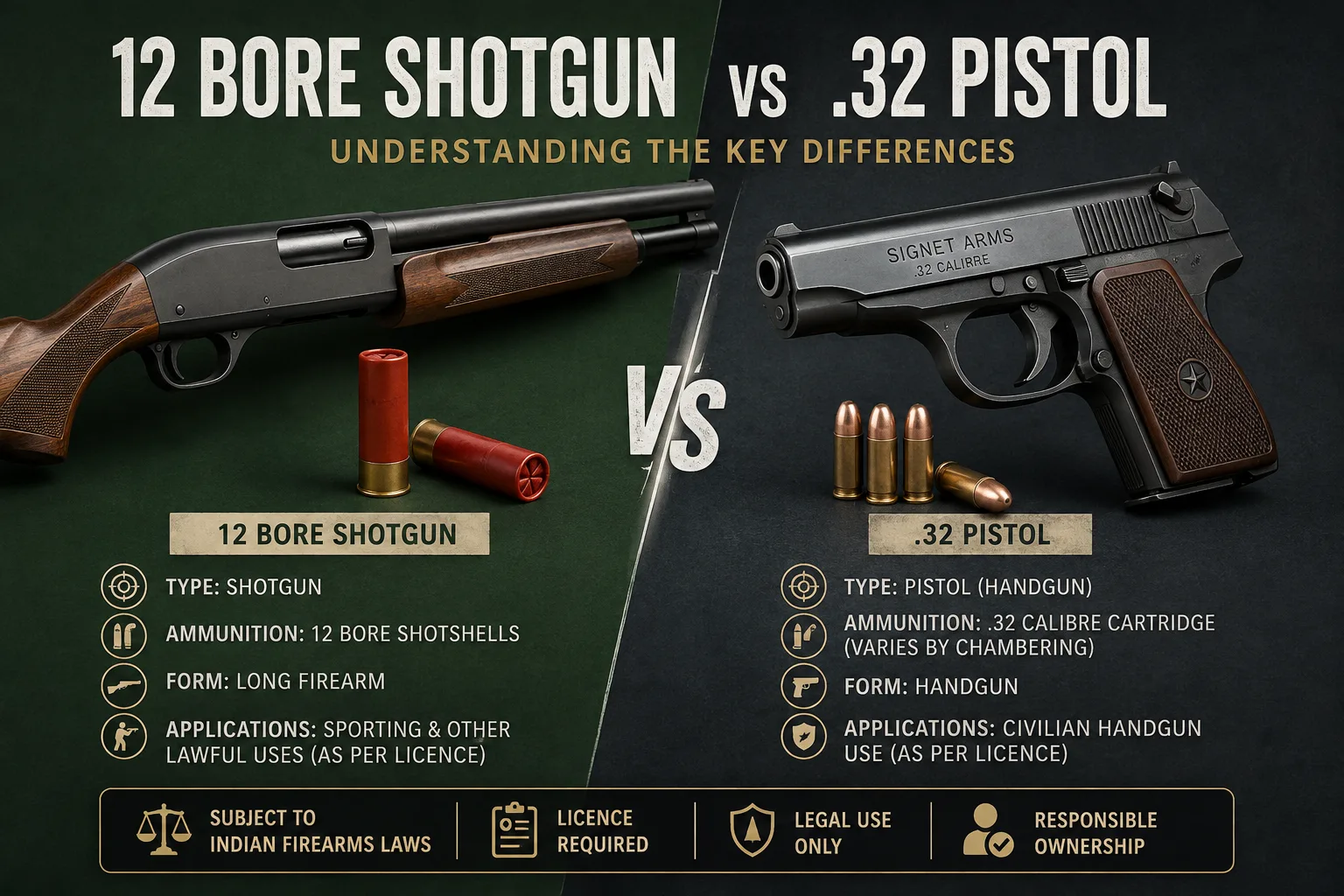
When people research firearms, two terms they may come across are 12 bore shotgun and .32 pistol. Although both are firearms, they represent very different types of platforms, with differences in design, ammunition, form factor and typical applications.
Understanding these distinctions is useful for anyone researching firearms in India, particularly because firearm ownership and possession are subject to the country’s regulatory framework.
This guide explains the key differences between a 12 bore gun and a .32 pistol at a high level, while also covering the terminology and legal considerations that prospective licence holders should understand.
What Is a 12 Bore Shotgun?
A 12 bore shotgun, commonly referred to as a 12-gauge shotgun, is a shotgun that uses 12-bore ammunition.
The term “12 bore” refers to the bore designation of the shotgun rather than a specific action or configuration. This means that a 12 bore shotgun can exist in different configurations.
For example, Signet Arms describes its portfolio as including a growing range of 12-gauge shotguns, alongside pistols and revolvers.
The term 12 bore gun is therefore broader than terms such as “12 bore pump action gun.” The latter refers to a particular action type within the broader category of 12-bore shotguns.
What Is a .32 Pistol?
A .32 pistol is a handgun associated with the .32 calibre designation.
Unlike a 12 bore shotgun, which is a shotgun platform, a .32 pistol is a handgun designed around a much smaller calibre designation.
The term “.32” can refer to different cartridges depending on the specific firearm and ammunition involved, so it should not be treated as a complete description of a particular firearm without considering the manufacturer’s specifications.
For prospective firearm owners, the exact firearm model, chambering and applicable licence conditions should always be verified through the manufacturer and relevant licensing authority.
12 Bore Shotgun vs .32 Pistol: Key Differences
The most straightforward way to understand the difference is to compare their broad characteristics.
| Feature | 12 Bore Shotgun | .32 Pistol |
|---|---|---|
| Firearm type | Shotgun | Handgun |
| Calibre designation | 12 bore / 12 gauge | .32 calibre |
| General form | Long firearm | Compact handgun |
| Ammunition terminology | 12-bore shotshells | .32-calibre cartridge, depending on chambering |
| Common configurations | Different shotgun actions and designs | Different handgun designs |
| Typical role | Sporting and other lawful applications depending on licence and firearm | Civilian handgun applications where legally authorised |
| Legal requirements in India | Subject to applicable firearms laws and licensing | Subject to applicable firearms laws and licensing |
The important point is that these are not simply two different calibres of the same type of firearm. They are different firearm categories with different designs and applications.
Difference in Firearm Design
One of the most obvious differences between a 12 bore shotgun and a .32 pistol is their physical design.
A shotgun is generally built as a long firearm, while a pistol is a handgun designed to be held and operated as a compact firearm.
This difference affects how each platform is designed and manufactured.
A shotgun typically has a longer overall configuration, while a pistol has a substantially more compact form.
The exact dimensions and configuration vary between individual firearm models, so specifications should always be checked against the manufacturer’s official information.
Difference in Ammunition
The ammunition terminology is another major distinction.
A 12 bore shotgun uses 12-bore shotshell ammunition, while a .32 pistol uses ammunition corresponding to its specific chambering.
The “.32” designation alone is not enough to identify every possible cartridge associated with that measurement. Different cartridges can have similar calibre designations, which is why ammunition must always correspond exactly to the firearm’s specified chambering.
For licensed firearm owners, using only the ammunition specified for the firearm and complying with all applicable legal requirements is essential.
12 Bore and .32 Are Not Directly Comparable Calibre Terms
It is also worth understanding that 12 bore and .32 describe different things.
The term “12 bore” is a traditional shotgun bore designation, while “.32” is a calibre designation generally associated with the approximate diameter of a projectile.
This is one reason why comparing the numerical values directly can be misleading.
They belong to different firearm and ammunition classification systems.
Different Firearm Configurations
A 12 bore shotgun is not limited to one particular action type.
Depending on the firearm, shotguns can be manufactured in different configurations, including:
- Break-action designs
- Pump-action designs
- Other shotgun action types
Therefore, 12 bore shotgun is the broader term, while 12 bore pump action gun describes a more specific configuration.
Similarly, pistols can differ significantly in their design and operating mechanisms.
For a prospective owner, the specific firearm model and its manufacturer’s specifications are more useful than relying only on broad category names.
Typical Applications
The appropriate application for a firearm depends on its design, the applicable law and the conditions of the relevant licence.
12 Bore Shotgun
Shotguns can be associated with sporting and other lawful applications, depending on the firearm, licence and applicable regulations.
.32 Pistol
A .32 pistol is a handgun platform that may be encountered in the civilian firearm market in India, subject to applicable licensing requirements and restrictions.
The fact that a firearm is available from a licensed manufacturer does not by itself mean that every individual can purchase or possess it. Applicable licensing and legal requirements must still be satisfied.
12 Bore Shotgun vs .32 Pistol for Civilian Firearm Ownership
In India, the comparison should not be reduced to a simple question of which firearm is “better.”
The more relevant question is whether a particular firearm is appropriate and legally available for the applicant’s circumstances.
The Arms Act, 1959 and Arms Rules, 2016 provide the framework governing arms and ammunition in India. The Ministry of Home Affairs maintains the applicable rules and related information through its official resources.
Licensing requirements, firearm categories, permitted use and other conditions can depend on the specific circumstances.
Licensing Considerations in India
Both a 12 bore shotgun and a .32 pistol fall within India’s broader firearms regulatory framework.
The Arms Rules, 2016 establish provisions concerning individual arms licences and the conditions associated with firearm possession and carrying.
For example, the Ministry of Home Affairs’ guidance explains that Rule 32 of the Arms Rules, 2016 contains restrictions concerning the carrying of firearms in public places.
This means that obtaining a licence is not the end of a firearm owner’s legal responsibilities. Licence holders must comply with the conditions applicable to their firearm and licence.
Anyone considering a firearm should therefore verify the current requirements with the relevant licensing authority.
12 Bore Shotgun vs .32 Pistol: Which Is Different?
The simplest answer is that they differ in almost every major category:
- Type: shotgun versus handgun
- Bore/calibre terminology: 12 bore versus .32 calibre
- Form factor: long firearm versus handgun
- Ammunition: 12-bore shotshell versus the specific .32 cartridge for the firearm
- Configurations: different shotgun and handgun designs
- Applications: dependent on the firearm and applicable legal permissions
- Licensing: subject to India’s firearms regulations
Therefore, a 12 bore shotgun and .32 pistol should not be viewed as interchangeable firearms.
How to Compare Firearms Responsibly
When researching different firearm categories, it is useful to focus on factual characteristics rather than relying on generic claims such as “best pistol” or “best shotgun.”
Important areas to research include:
Manufacturer and Model
Different manufacturers and models can have different specifications, designs and intended applications.
Calibre or Chambering
Always verify the exact chambering specified by the manufacturer rather than relying solely on a broad calibre term.
Intended Lawful Application
The appropriate firearm depends on the intended lawful use and the conditions under which the firearm may be licensed.
Manufacturing Quality
Manufacturing infrastructure, quality assurance, engineering standards and regulatory compliance are relevant factors when researching a firearm manufacturer.
Licensing Requirements
Before considering any firearm purchase in India, prospective owners should understand the applicable licensing requirements and confirm them with the relevant authority.
Signet Arms and Its Firearm Portfolio
Signet Arms describes itself as an Indian firearm manufacturer with more than 60 years of experience in the firearms business through its long-running affiliate, Rajput Gun Service. The company combines that experience with modern manufacturing as a unit of Signet Conductors Pvt Ltd, based in Rewa, Madhya Pradesh.
Its stated portfolio includes pistols and revolvers as well as a growing range of 12-gauge shotguns.
This makes understanding the distinction between firearm categories particularly relevant when researching the products and broader manufacturing capabilities of an Indian firearm company.
Frequently Asked Questions
Is a 12 bore gun the same as a .32 pistol?
No. A 12 bore gun generally refers to a shotgun chambered for 12-bore ammunition, while a .32 pistol is a handgun associated with a .32 calibre designation.
Is 12 bore the same as 12 gauge?
In common shotgun terminology, “12 bore” and “12 gauge” refer to the same general shotgun bore designation.
Is a 12 bore shotgun a pistol?
No. A 12 bore shotgun is a shotgun, while a pistol is a handgun. They are different firearm categories.
Is a 12 bore pump action gun the same as a 12 bore shotgun?
Not exactly. A 12 bore shotgun is the broader category. A pump-action shotgun is one particular configuration within that category.
What does .32 mean in a pistol?
The “.32” designation identifies the calibre associated with the firearm, but the exact cartridge should always be verified from the firearm’s specifications because calibre terminology alone may not identify the complete cartridge.
Are 12 bore shotguns and .32 pistols legal in India?
Firearms in India are subject to the Arms Act, 1959, Arms Rules, 2016 and applicable licensing requirements. Whether a particular firearm may be lawfully possessed depends on the applicable legal and licensing conditions.
Can civilians own firearms in India?
Civilian firearm possession is regulated and requires the applicable authorisation. The relevant licensing authority assesses applications according to the applicable law and rules.
Which is better, a 12 bore shotgun or a .32 pistol?
There is no universal answer. They are different firearm categories designed for different applications. Any lawful firearm decision should be based on the specific purpose, applicable licence, manufacturer specifications and legal requirements rather than a generic “best” ranking.
Final Thoughts
A 12 bore shotgun and a .32 pistol are fundamentally different firearms, even though both fall under the broader category of firearms.
The 12 bore shotgun is a shotgun platform identified by its 12-bore or 12-gauge designation, while the .32 pistol is a handgun associated with a .32 calibre designation. Their designs, ammunition terminology, configurations and potential applications are different.
For anyone researching firearms in India, understanding these distinctions is only one part of the process. The applicable licensing requirements and conditions are equally important, and current information should always be verified through the relevant authorities.
Signet Arms’ portfolio spans both handgun and shotgun categories, while its manufacturing operations are focused on developing firearms in India.