
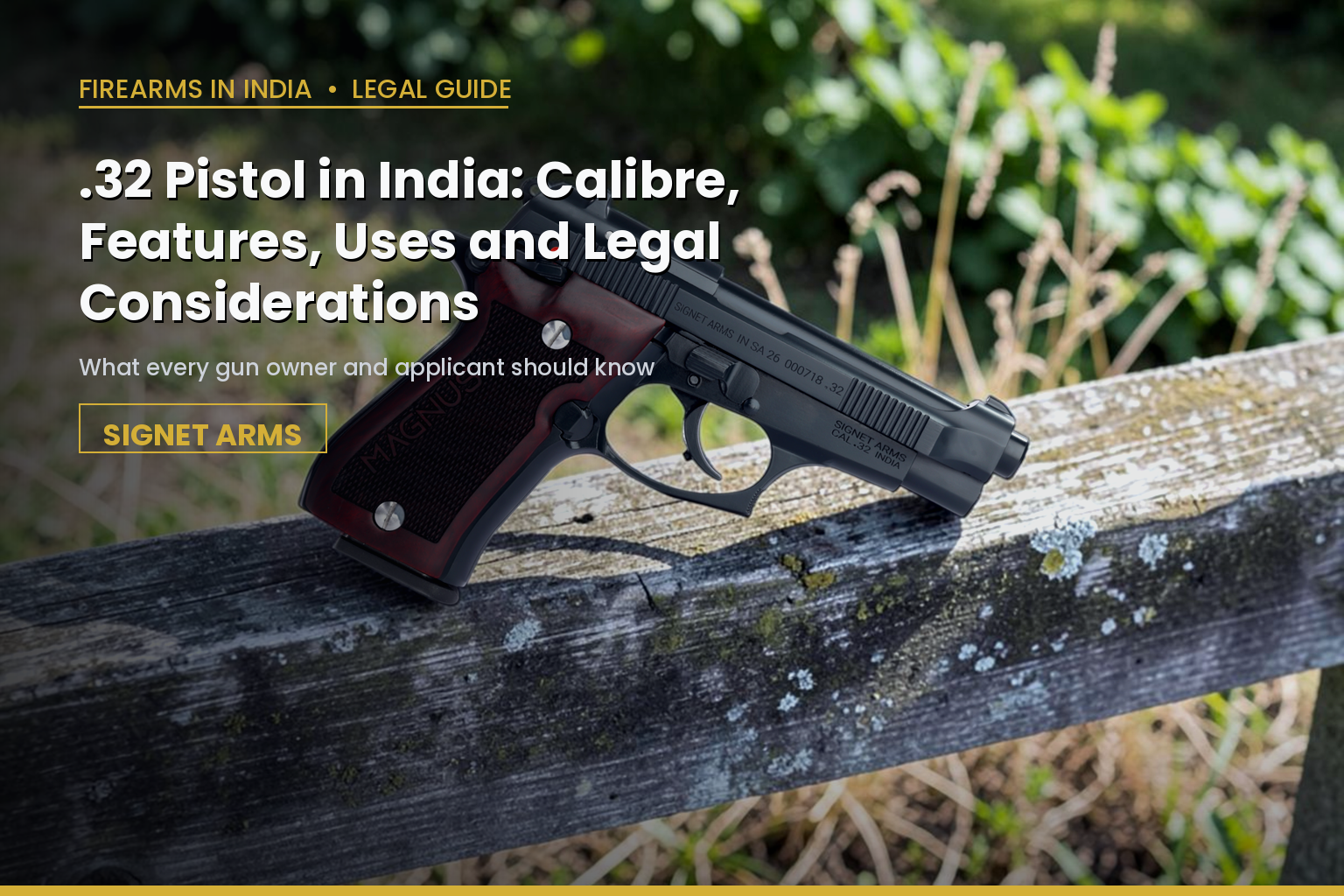
When researching firearms in India, the .32 Pistol is a term that commonly comes up when discussing handgun categories, calibre specifications, lawful ownership and licensing.
However, understanding a .32 pistol involves more than knowing its calibre. The exact chambering, firearm model, design and manufacturer specifications can differ, while possession and carrying are regulated under India’s firearms laws.
This article explains what a .32 calibre pistol is, its general features, common lawful applications, important .32 pistol legal requirements, and the role of a firearm licence in India.
It also highlights why prospective owners should verify current rules and licence conditions with the appropriate authorities before making any decision.
What Is a .32 Pistol?
A .32 Pistol is a handgun associated with a .32 calibre designation. The term describes a broad calibre category rather than one specific firearm model.
The “.32” designation is not, by itself, enough to identify every technical detail of the ammunition or firearm.
Different cartridges can have similar calibre descriptions, so the exact chambering should always be checked against the manufacturer’s official specifications.
As with other firearms, the specific model, configuration and applicable legal classification are important when researching a .32 calibre pistol.
The reference material also emphasizes that prospective owners should verify the exact firearm model, chambering and licence conditions rather than relying only on a broad calibre term.
Understanding the .32 Calibre
What Does .32 Mean?
The .32 designation is a calibre measurement commonly associated with the approximate diameter of a projectile. It is expressed using the inch-based system.
However, calibre terminology can be more complicated than the number suggests. A calibre name should not automatically be treated as the complete specification of a cartridge.
For this reason, a person researching a .32 pistol in India should look at the exact chambering specified by the manufacturer and ensure that all ammunition-related information corresponds to that firearm.
Why Exact Chambering Matters
The same general calibre terminology can appear in descriptions of different cartridges. This is why the firearm’s official documentation is more reliable than informal references.
For legal firearm owners, following the manufacturer’s specifications and applicable regulations is essential.
Ammunition should only correspond to the firearm’s specified chambering.
Features of a .32 Pistol
The features of a .32 Pistol vary depending on the manufacturer and model. There is no single design that applies to every handgun carrying a .32 designation.
Design and Construction
A pistol is generally a compact handgun rather than a long firearm. Individual models can differ in their frame construction, operating mechanism, sights, controls and overall dimensions.
Some models may also differ in how their ammunition is held, but those specifications should always be checked from the manufacturer’s official product information rather than assumed from the .32 designation alone.
Model-Specific Specifications
When comparing a .32 calibre pistol, useful specifications may include overall dimensions, weight, materials, operating system and other manufacturer-provided details.
These specifications can vary considerably between models. Therefore, the best approach is to compare the exact models being considered instead of treating every .32 pistol as identical.
Uses of a .32 Pistol
A .32 Pistol may be encountered in the context of civilian firearm ownership where possession is legally authorised.
Depending on the firearm and applicable permissions, firearms can also be associated with sporting and other lawful purposes.
The important distinction is between a firearm’s general capability and its legally permitted use.
Having access to a firearm does not automatically mean that every possible use or method of carrying it is permitted.
Civilian Firearm Ownership
Civilian firearm ownership in India is regulated. The Arms Act, 1959 includes provisions concerning licences for the acquisition and possession of firearms and ammunition.
Therefore, anyone considering a .32 pistol must look beyond its physical features and understand the applicable licensing requirements.
Lawful and Responsible Use
Firearm ownership comes with responsibilities involving safe handling, secure storage and compliance with licence conditions.
The appropriate lawful application depends on the circumstances and the permissions granted by the relevant authority.
Legal Considerations for a .32 Pistol in India
The .32 pistol legal requirements are governed within India’s broader firearms regulatory framework, particularly the Arms Act, 1959 and the Arms Rules, 2016. The Ministry of Home Affairs provides the official rules and related guidance.
Firearm Licence in India
Section 3 of the Arms Act, 1959 establishes the requirement for a licence for the acquisition and possession of firearms and ammunition, subject to the Act and applicable provisions. The Act also contains provisions concerning the grant, renewal and other aspects of firearm licences.
This means a firearm cannot simply be purchased and possessed on the assumption that it is permitted for civilian ownership. The relevant licensing process and eligibility requirements must be followed.
Carrying a Firearm in Public
Licensing also does not mean that a handgun may be carried without restrictions. The Ministry of Home Affairs states that Rule 32 of the Arms Rules, 2016 contains restrictions concerning the carrying of firearms in public places. For handguns, the rule specifies permitted forms of carrying, including a suitable holster or similar holder or a rucksack or similar holder, subject to the applicable provisions.
Because firearm laws and official requirements can be updated, current information should always be confirmed through the Ministry of Home Affairs and the relevant licensing authority. The MHA continues to publish the Arms Rules and related notifications on its official website.
How to Research a .32 Pistol Responsibly
Researching a .32 Pistol is best approached by looking at factual, model-specific and legal information rather than generic claims about which handgun is “best.”
- Check the Manufacturer and Model
Start with the exact manufacturer and model. Different firearms can have substantially different specifications even when they share a broad calibre designation.
- Verify the Exact Chambering
Always check the chambering specified by the manufacturer. The .32 label alone may not provide enough information to identify the precise cartridge.
- Understand the Licensing Requirements
Before considering acquisition or possession, understand the applicable firearm licence in India requirements and confirm them with the relevant licensing authority.
- Consider Legal Responsibilities
Responsible ownership includes complying with licence conditions, applicable storage requirements and restrictions on carrying or using firearms.
Best .32 Pistol in India
Signet Arms’s .32 Pistols
For those looking for a .32 pistol in India, Signet Arms offers two options in its .32 ACP range: the Magnus and Magnus XT.
Both are designed and manufactured in India, combining Signet Arms’ modern manufacturing capabilities with its long-standing firearms industry experience.
The Magnus XT features a slightly longer barrel than the standard Magnus, giving it a marginally longer sight radius while retaining the same platform, magazines and controls.
Frequently Asked Questions
1. Is a .32 pistol legal in India?
A .32 pistol may be legally possessed only when the applicable licensing and legal requirements are satisfied. Firearms possession is regulated under the Arms Act, 1959 and Arms Rules, 2016.
2. What does .32 mean in a pistol?
“.32” is a calibre designation associated with the firearm and its ammunition. It does not necessarily identify the complete cartridge specification, so the exact chambering should be checked in the manufacturer’s documentation.
3. Is every .32 pistol the same?
No. Different manufacturers and models can vary in design, dimensions, materials, operating mechanisms and other specifications. The broad .32 designation does not make all models identical.
4. Do civilians need a firearm licence for a .32 pistol in India?
Yes, firearm acquisition and possession are regulated and generally require the applicable licence under the Arms Act, 1959, subject to the law and relevant conditions.
5. Can a licensed .32 pistol be carried anywhere in India?
No. Carrying a licensed handgun in public is subject to restrictions under the Arms Rules, 2016. Rule 32 sets out requirements concerning how firearms, including handguns, may be carried in public places.
6. Where can I check the current rules for a .32 pistol?
The Ministry of Home Affairs is an important official source for the Arms Act, Arms Rules and related guidance. Current requirements should also be confirmed with the relevant licensing authority because individual circumstances and applicable rules can affect the licensing position.
Conclusion
A .32 Pistol is a handgun associated with a .32 calibre designation, but the term alone does not describe one specific firearm. Models can vary in their design, specifications, chambering and features, which is why manufacturer information should always be consulted when researching a particular firearm.
For anyone researching a .32 calibre pistol in India, legal considerations are just as important as technical specifications. The Arms Act, 1959 and Arms Rules, 2016 establish the broader framework for firearm acquisition, possession and carrying in India.
Understanding the applicable firearm licence in India, checking current government requirements and following all relevant legal conditions are essential parts of responsible firearm ownership.
Since regulations and official guidance can change, the latest requirements should always be verified through the Ministry of Home Affairs and the appropriate licensing authority.